
 ENG
ENG  ESP
ESP 
1. A New Vision for Your Life
Welcome! If you're reading this guide, you're probably experiencing an exciting moment: the possibility of seeing the world with new clarity. Modern cataract surgery has evolved from a restorative procedure to an opportunity to refine your vision and adapt it to your lifestyle. At the heart of this transformation is the intraocular lens (IOL), a small artificial lens that replaces the cloudy lens of your eye.
Choosing an IOL is one of the most important and personal decisions you'll make in this process. It's not just about seeing, but about how you want to see. This guide is designed to empower you, giving you the knowledge you need to understand your options. Our goal is that, by the end of this guide, you'll feel prepared to have an informed and confident conversation with your surgeon, and together, choose the perfect path for your future vision.
2. The Fundamental Decision: Range of Vision vs. Visual Quality
Before learning about the types of lenses, it is crucial to understand the most important concept: there is a fundamental trade-off between the range of vision and pure visual quality.
- Vision Range: Refers to the ability to see clearly at multiple distances (far, intermediate and near) without relying on glasses.
- Pure Visual Quality: Refers to maximum sharpness, contrast and absence of visual phenomena such as halos or glare around lights, especially at night.
Imagine a spectrum: at one end you have the sharpest vision with the highest possible contrast, but only at a single distance. At the other end, you have the ability to see at all distances, but with a slight reduction in optical quality and the possibility of perceiving halos. There is no single lens that is "the best" for everyone; there is only the lens that is "the best for your lifestyle."
Now that you understand this fundamental principle, let's learn about the four main types of lenses available.
3. Know Your Options: The 4 Types of Intraocular Lenses
Each type of lens represents a different philosophy on how to handle light to optimize your vision, balancing range and quality.
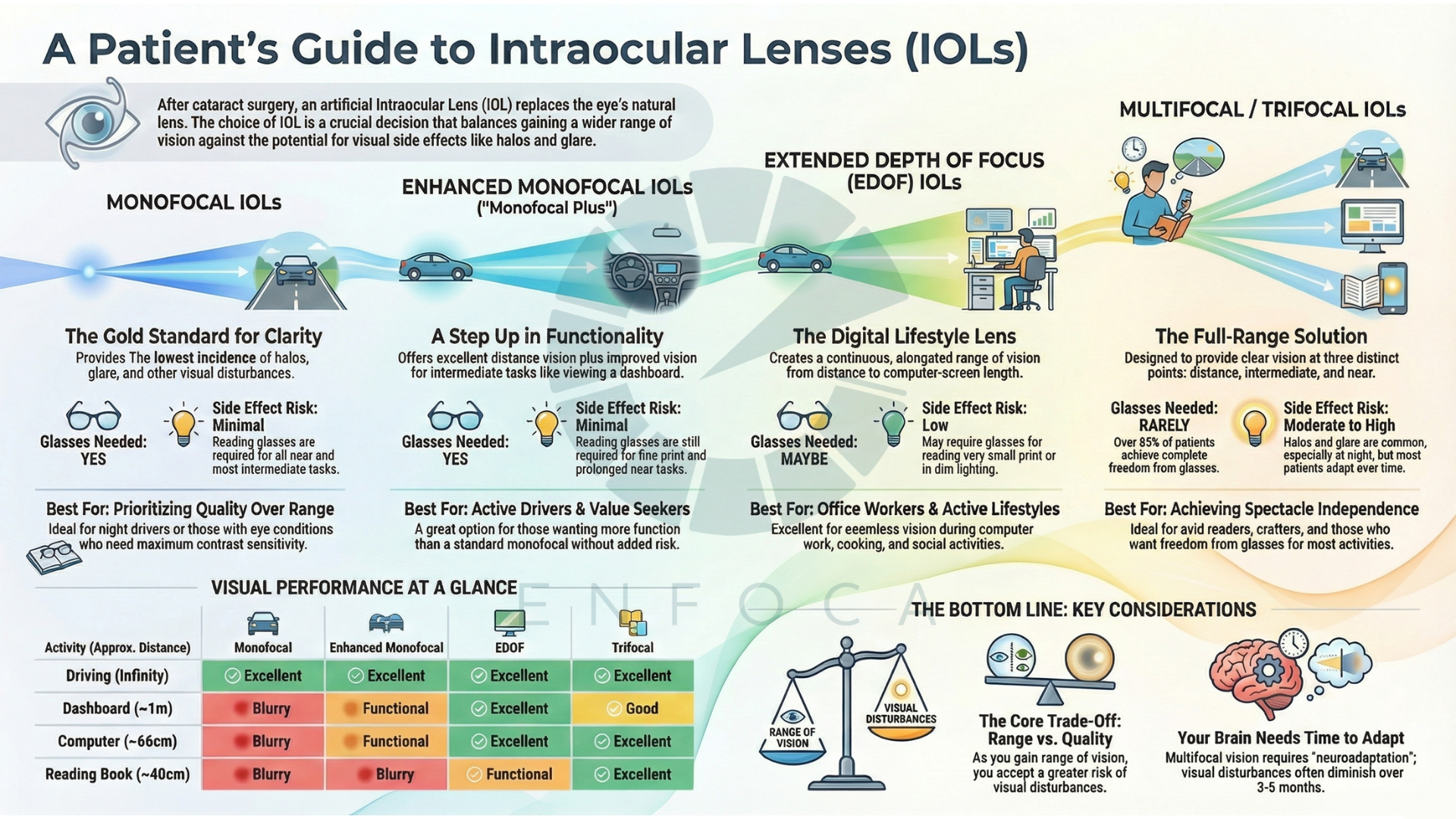
3.1. Single Vision Lens: Maximum Clarity at a Single Distance
This lens is designed to prioritize pure visual quality above all else. It offers a single point of focus, typically for distance vision, providing the sharpest vision, with the highest contrast and the lowest risk of halos and glare of all the options. It's the ideal choice for people who prioritize night vision quality (such as frequent drivers) or who have other eye conditions (such as macular degeneration, glaucoma, or an irregular cornea) that already compromise contrast sensitivity, a quality this lens maximizes. Its main limitation is that, by sacrificing the field of vision, you'll need glasses for reading and most intermediate-distance tasks.
3.2. Monofocal Plus Lens (or Improved Monofocal): Distance Clarity with Extra Help
Consider this lens a smart evolution of the single-vision lens. It maintains excellent pure visual quality (sharp distance vision and minimal risk of halos) but subtly extends the focusing range. This "extra help" provides functional intermediate vision, very useful for viewing your car's dashboard, supermarket prices, or a desktop computer. However, by still prioritizing quality over full range, you will still need glasses for reading small print or for prolonged close-up work.
3.3. Extended Focus Lens (EDOF): The Solution for Digital Life
EDOF lenses are designed to offer an exceptional balance between field of vision and visual quality. Unlike older lenses, non-diffractive EDOF lenses do not use concentric rings to split light. Instead, they utilize wavefront shaping technology to extend the field of vision. This is the key to their success: they achieve an extended field of vision without the penalty of significant halos and glare, offering a safety profile similar to that of a single-vision lens.
Instead of a single sharp peak, they create a high-quality "plateau" of focus. This allows you to move seamlessly between viewing the road, the car's dashboard, and the GPS screen clearly, without the visual "jumps" that can occur with other technologies. While near vision is functional, lens independence for distance and intermediate vision is very high, but for reading small print, statistics show that only about 33-50% of patients achieve complete independence.
3.4. Trifocal Lens: The Greatest Lens Independence
This lens prioritizes the wide field of vision, accepting a trade-off in pure visual clarity due to halos. It is designed to offer maximum spectacle independence, using advanced optics to split light and create three clear focus points: far, intermediate, and near. It boasts the highest overall spectacle independence rate, exceeding 85-90% in most studies.
This versatility has an unavoidable optical counterpart: the perception of halos or rings around lights at night. It's important to be clear: almost all trifocal lens wearers see them, but research shows that the vast majority adapt and the brain learns to ignore them. Only a small percentage (around 3-5%) describe them as "very annoying" in the long run. Therefore, it's not so much about whether you'll see them, but rather your ability to adapt to them.
To better visualize these differences, let's look at a direct comparison of their performance.
4. Comparative Table: Lens Performance at a Glance
This table summarizes the key features of each lens type to help you quickly and clearly compare your options.
| Feature | Monofocal | Monofocal Plus | EDOF (Non-Diffractive) | Trifocal |
| Long-distance vision | Excellent | Excellent | Excellent | Excellent |
| Intermediate Vision | Poor | Good | Very good | Excellent |
| Close-up View | Poor | Poor | Functional | Excellent |
| Need for Glasses | Yes (for near and intermediate) | Yes (mainly for close-up) | Occasional (for very fine lettering) | No (maximum independence) |
| Risk of Halos/Flashes | Minimum | Minimum | Low | Moderate to High |
| Contrast Sensitivity | Excellent | Excellent | Very good | Reduced |
With these characteristics in mind, it's time to reflect on your own life and priorities.
5. Self-assessment: Which Lens Fits Your Lifestyle?
Use these descriptions to identify which profile is most like you and which lenses best align with your needs.
5.1. Analyze your Daily Activities
- The Night Driver or Pilot: Your top priority is safety and artifact-free night vision. You value maximum clarity without glare that could distract you on the road.
- Recommended lenses: The Monofocal and Monofocal Plus lenses are the reference choice due to their optical purity and lack of artifacts. The non-diffractive EDOF is an excellent alternative for those who want a wider functional range (see chart) without a significant increase in the risk of halos.
- The Office Professional or "Digital Native": You spend a large part of the day in front of a computer screen, using a tablet, or switching your view between your monitor and documents.
- Recommended lens: The sharp, continuous mid-range viewing of the EDOF lens is ideal for these tasks, providing visual comfort without the focus jumps of other lenses.
- The Passionate Reader or Craftsman: You enjoy hobbies that require sustained and very sharp close-up vision, such as reading books, sewing, building scale models, or fly fishing.
- Recommended lens: The Trifocal lens is the only one that consistently offers the level of near visual acuity needed for these detailed activities without the need for glasses.
- The Active and Versatile Person: You seek a balance to perform a wide variety of activities (sports, cooking, social gatherings, cell phone use) and value above all the freedom of not wearing glasses.
- Recommended lenses: EDOF and Trifocal lenses are strong candidates. Your choice will depend on your personal tolerance for the risk of perceiving halos in exchange for greater independence.
5.2. Define your Personality and Tolerance
This is a surprisingly important factor. The research is strikingly clear: patients with more relaxed, adaptable, and open-minded personalities tend to be more satisfied. In contrast, personalities that the Source Context describes as highly perfectionistic, controlling, or with obsessive traits may have difficulty ignoring halos, as they seek a perfection that the physics of these lenses cannot provide. Think honestly: which profile best describes you?
Advanced Strategies: Personalizing Your Binocular Vision
Sometimes, the ideal solution isn't to use the same lens in both eyes. Your surgeon can employ advanced strategies to further personalize your vision.
- Blended Vision (Mini-Monovision): This technique involves slightly adjusting one eye for improved intermediate or near vision, while the other remains perfectly focused at a distance. It's a powerful strategy with Monofocal Plus or EDOF lenses to increase the range of vision without resorting to trifocal lenses.
- Mix-and-Match Lens Combinations: In some cases, one type of lens can be implanted in one eye and another in the other. For example, an EDOF lens in the dominant eye for excellent distance vision without halos, and a trifocal lens in the other eye to enhance reading.
These are powerful tools that allow your surgeon to create a solution tailored to your needs. Don't hesitate to ask if any of these options might be right for you.
Once you choose an advanced lens, your brain begins a fascinating adjustment process. Understanding this is key to your success.
6. A Key Factor: The Neuroadaptation of Your Brain
Choosing the right lens is just the first step. Long-term success, especially with EDOF and trifocal lenses, depends on a process called neuroadaptation.
- What is it? Neuroadaptation is your brain's incredible ability to adapt to new visual information received from the lens. Over time, it learns to interpret new images, actively filtering out unwanted phenomena, such as halos, until they cease to be a distraction.
- A realistic timeline: This process is not instantaneous and varies depending on the lens. While with a single-vision lens adaptation takes only days, with an EDOF lens it can take 3 to 6 months. With trifocal lenses, the journey can be longer, requiring 6 to 12 months for the brain to effectively filter out halos.
- Success factors: It is crucial to understand that neuroadaptation cannot begin successfully if other visual problems exist. Factors such as dry eye or even a minimal residual refractive error Uncorrected astigmatism or myopia (after surgery) can create blurred vision that prevents the brain from adapting properly. Therefore, the success of these lenses depends on flawless surgery and rigorous postoperative follow-up to optimize the health of the ocular surface. Furthermore, certain characteristics facilitate this process:
- Be under 60 years old.
- Having an adaptable and flexible personality.
- Maintain realistic expectations about the final outcome.
Armed with this knowledge, you're ready for the most important step: talking to your specialist.
7. Prepare your conversation with the surgeon
You've done a great job researching. Now, the goal is to collaborate with your doctor. Bring this guide and your thoughts to your appointment. To help facilitate the conversation, here's a list of questions you can ask:
- Based on my daily activities, such as (e.g., driving at night, reading books, working on the computer), what type of lens do you think would best align with me and why?
- Considering my overall eye health, am I a good candidate for an EDOF or Trifocal lens?
- With the option you recommend, what kind of visual phenomena (halos, flashes) should I realistically expect in the first few months?
- What is the plan if I have difficulty adjusting to the new lens after surgery?
The Best Decision Is Yours
As you've seen, there's no single answer or "perfect" lens. The goal is to find the ideal balance between cutting-edge technology and your lifestyle, activities, and personality. The choice comes down to where you feel most comfortable on the spectrum between vision range and pure visual quality.
Use this guide as your starting point. Trust your priorities and prepare for an exciting future with a renewed vision, knowing you've made the best possible decision for yourself.


